5 Awesome Vvveb Alternatives
 Yulei Chen
Vvveb is an open-source CMS and website builder with a powerful drag-and-drop page builder, built-in e-commerce, and headless CMS capabilities via GraphQL and REST APIs. It supports multiple databases (SQLite, MySQL, PostgreSQL), runs on PHP, and is completely free under the AGPL-3.0 license. Since Vvveb is fully self-hosted, your main cost is the server itself. You can self-host Vvveb on Sliplane for just €9/month with one-click deployment, HTTPS, persistent storage, and zero server management. Check out our easy deploy guide to get started in minutes.
But maybe Vvveb isn't quite the right fit for your project. Maybe you need a more mature plugin ecosystem, a dedicated publishing platform, or a headless CMS with a bigger community. Let's look at 5 awesome alternatives!
1. WordPress
WordPress is the world's most popular CMS, powering over 40% of all websites on the internet. While Vvveb offers a modern drag-and-drop builder out of the box, WordPress brings an unmatched ecosystem of over 60,000 plugins and thousands of themes that let you build virtually anything.
- Features: Block editor (Gutenberg) with drag-and-drop content creation, 60,000+ plugins, thousands of free and premium themes, built-in user management, SEO tools, e-commerce via WooCommerce, multilingual support, REST API, and a massive community.
- Why You Should Use It: If you need the largest plugin and theme ecosystem available, WordPress is unbeatable. Whatever feature you need, there's probably a plugin for it. The community support, documentation, and developer resources are unmatched by any other CMS. WooCommerce alone powers millions of online stores.
- Why Not: WordPress can be resource-heavy and slow without proper optimization. The reliance on plugins for basic functionality means more maintenance and potential security vulnerabilities. The editing experience is less intuitive than Vvveb's true WYSIWYG drag-and-drop builder.
- Pricing: WordPress.org (self-hosted) is free. WordPress.com hosting starts at $9/month (Personal), $18/month (Premium), $40/month (Business), and $70/month (Commerce). Self-hosting on Sliplane costs around €9/month.
2. Ghost
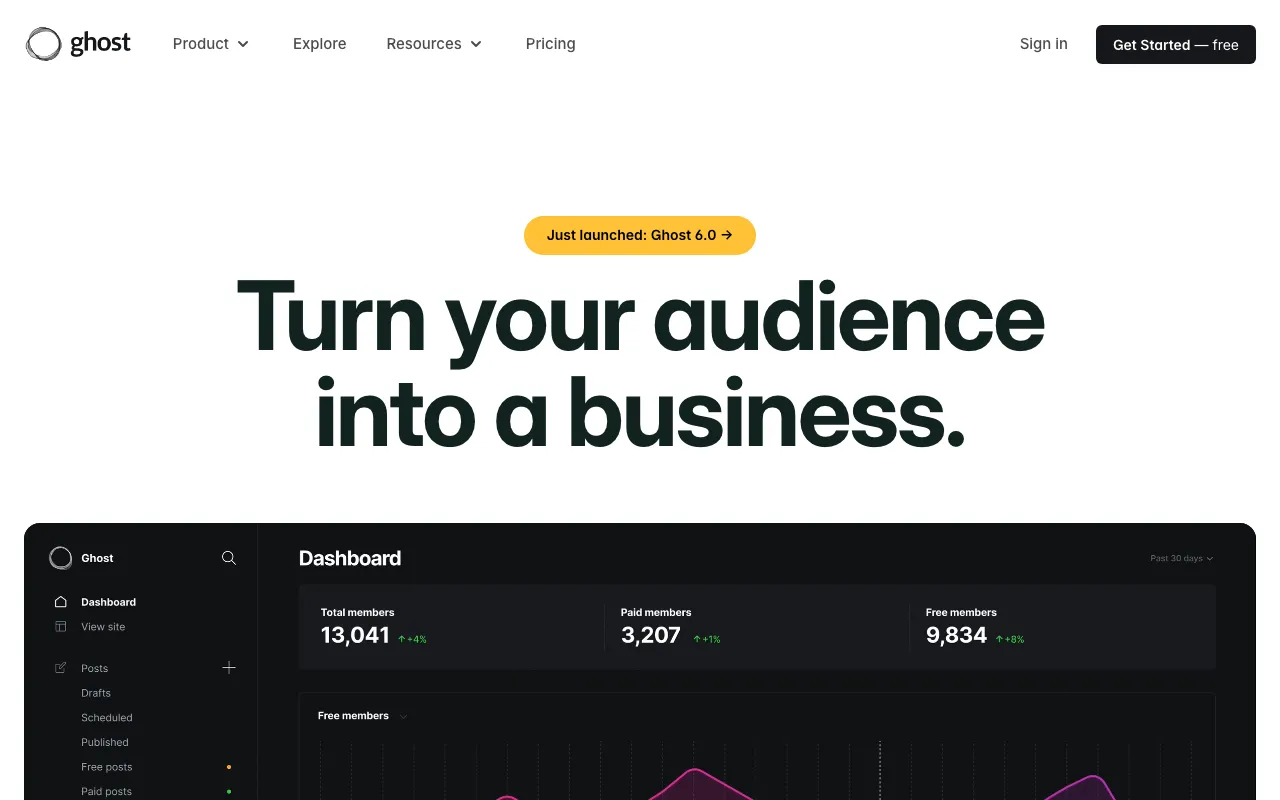
Ghost is a modern, open-source publishing platform built specifically for professional bloggers, journalists, and content creators. While Vvveb is a general-purpose website builder, Ghost focuses on content publishing with built-in newsletters, memberships, and monetization.
- Features: Clean Markdown editor, built-in email newsletter system, native membership and subscription management, SEO optimized out of the box, custom themes with Handlebars templating, integrations via Zapier and native webhooks, and 0% platform transaction fees on paid subscriptions.
- Why You Should Use It: If your primary goal is publishing content and building a paid audience, Ghost is purpose-built for that. The built-in newsletter and membership system means you don't need separate tools for email marketing or payment processing. It's fast, lightweight, and the editor is a joy to use for long-form writing.
- Why Not: Ghost is not a general-purpose website builder. There's no drag-and-drop page builder like Vvveb offers. Building custom pages requires theme development with Handlebars. E-commerce beyond digital subscriptions isn't natively supported.
- Pricing: Self-hosted Ghost is free. Ghost(Pro) managed hosting starts at $18/month (Starter, 1 user), $29/month (Publisher, 3 users), and $199/month (Business, 10 users). Self-hosting on Sliplane costs around €9/month.
3. Directus
Directus is an open-source headless CMS and data platform that wraps any SQL database with a real-time API and an intuitive admin app. Where Vvveb gives you a visual page builder, Directus gives you complete control over your data model and lets you build the frontend however you want.
- Features: Auto-generated REST and GraphQL APIs, visual data studio for managing content, role-based access control with granular permissions, file management with on-the-fly transformations, flows for automation, support for PostgreSQL, MySQL, SQLite, and more, and a marketplace for extensions.
- Why You Should Use It: If you want to decouple your content from the presentation layer, Directus is an excellent choice. It works with any existing SQL database without migration, so you can add a CMS layer to your current data. The admin app is polished and non-technical team members can use it comfortably. It's ideal for building custom frontends with React, Vue, or any framework.
- Why Not: Directus is a headless CMS, so there's no built-in page builder or theme system. You need to build your own frontend, which adds development time. It's more of a backend content platform than a ready-to-go website solution like Vvveb.
- Pricing: Self-hosted Directus is free (for organizations under $5M revenue). Directus Cloud starts at $99/month (Professional, 5 users). Enterprise pricing is custom. Self-hosting on Sliplane costs around €9/month.
4. Strapi
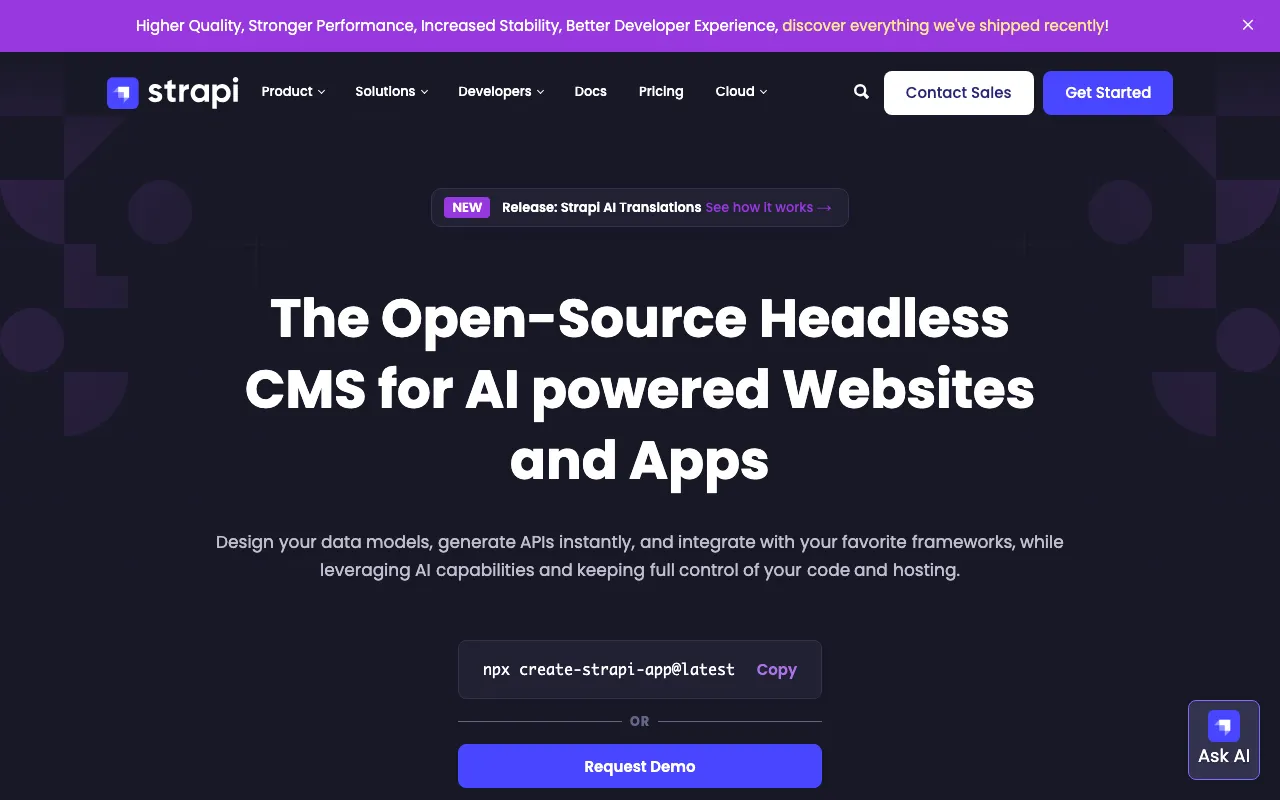
Strapi is the leading open-source headless CMS built with Node.js. Like Directus, it takes a headless approach, but Strapi focuses on developer experience with a content-type builder, plugin system, and a growing marketplace.
- Features: Visual content-type builder, auto-generated REST and GraphQL APIs, role-based access control, media library with asset management, plugin marketplace, internationalization (i18n) support, draft and publish workflow, and webhooks for integrations.
- Why You Should Use It: If you're a JavaScript/TypeScript developer building a modern frontend, Strapi fits perfectly into your stack. The content-type builder lets you define your data models visually without writing code, and the generated APIs work seamlessly with frameworks like Next.js, Nuxt, or Astro. The plugin ecosystem is growing fast and the community is very active.
- Why Not: Like Directus, Strapi requires you to build your own frontend. It's Node.js-based, which means higher memory usage compared to Vvveb's lightweight PHP setup. The free Cloud plan pauses after inactivity, and paid plans can get expensive quickly with overage fees.
- Pricing: Self-hosted Strapi is free. Strapi Cloud has a free plan (with inactivity pause), Essential at $18/month, Pro at ~$90/month, and Scale at ~$450/month. Self-hosting on Sliplane costs around €9/month.
5. Webstudio
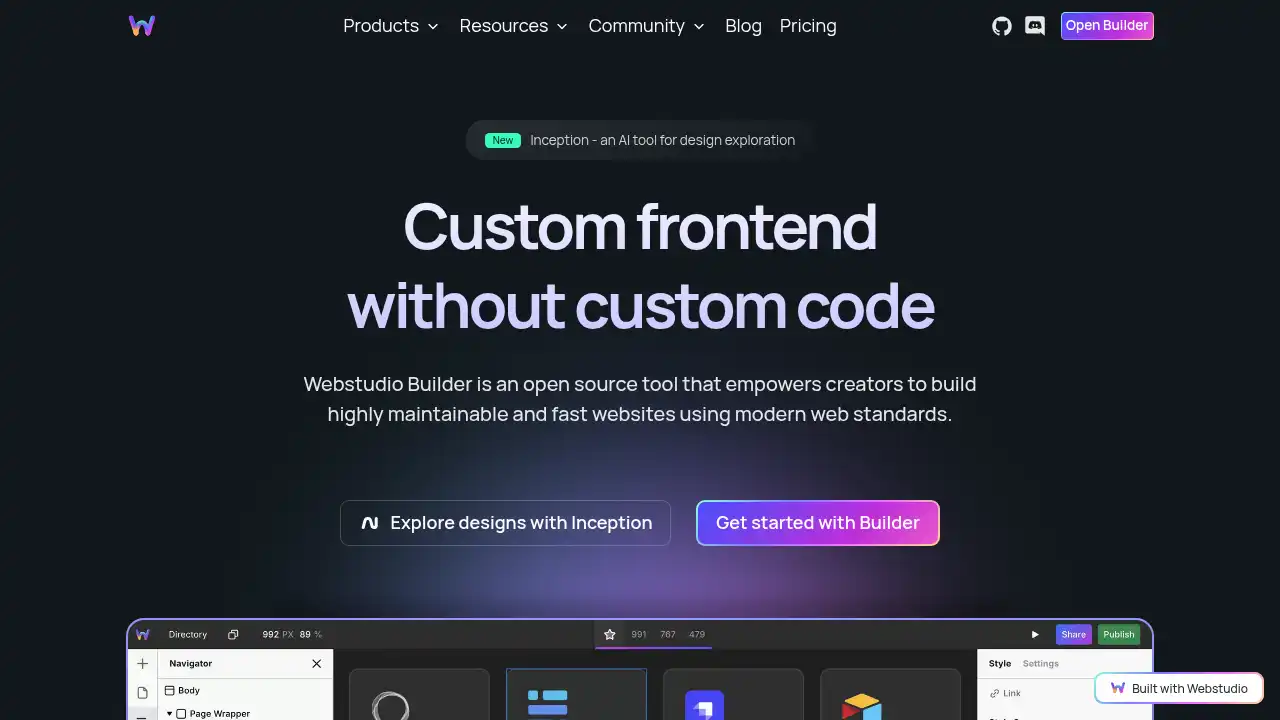
Webstudio is an open-source visual website builder that's the closest alternative to Vvveb in terms of approach. It combines a Webflow-like drag-and-drop editor with the freedom of self-hosting and open-source licensing.
- Features: Visual drag-and-drop builder with CSS-level control, responsive design tools, CMS integrations, form handling, custom code embedding, SEO controls, asset management, and self-hosting support via Docker.
- Why You Should Use It: If you love Vvveb's visual builder approach but want something with a more modern, Webflow-inspired design experience, Webstudio is the one. It gives you pixel-perfect control over your layouts without writing code, and the open-source license means you own everything. It's great for designers and agencies who want visual freedom without vendor lock-in.
- Why Not: Webstudio is newer and less mature than Vvveb in some areas. It doesn't have built-in e-commerce or the same breadth of CMS features. The plugin ecosystem is still small, and self-hosting documentation is more limited. The learning curve for the CSS-level controls can be steep for beginners.
- Pricing: Free Hobby plan (subdomain only, 250MB storage). Pro at $15/month (yearly, custom domains, 20GB storage). Team at $35/month (yearly, workspaces, member roles). Self-hosting is free.
Conclusion
| Tool | Best For | Ease of Setup | Focus | Cloud Pricing |
|---|---|---|---|---|
| Vvveb | Visual website building, e-commerce | Easy | All-in-one CMS + builder | Free (self-host only) |
| WordPress | Plugin ecosystem, any website type | Easy | General-purpose CMS | WordPress.com $9-70/mo |
| Ghost | Blogging, newsletters, memberships | Moderate | Publishing platform | Ghost(Pro) $18-199/mo |
| Directus | Custom data models, headless APIs | Moderate | Headless data platform | Directus Cloud $99/mo+ |
| Strapi | JS developers, headless frontends | Moderate | Headless CMS | Strapi Cloud free-$450/mo |
| Webstudio | Visual design, Webflow alternative | Moderate | Visual website builder | Webstudio free-$35/mo |
Each tool fills a different niche: WordPress for the largest ecosystem and flexibility, Ghost for professional publishing and monetization, Directus for headless data management with any SQL database, Strapi for JavaScript-first headless CMS, and Webstudio for a modern visual builder experience.
Vvveb remains a solid choice if you want an open-source CMS with a true drag-and-drop builder, built-in e-commerce, and lightweight PHP performance. But if your needs lean more toward content publishing, headless APIs, or a specific developer ecosystem, one of these alternatives might be a better fit.
If you want to self-host Vvveb or any of these alternatives, check out these guides: